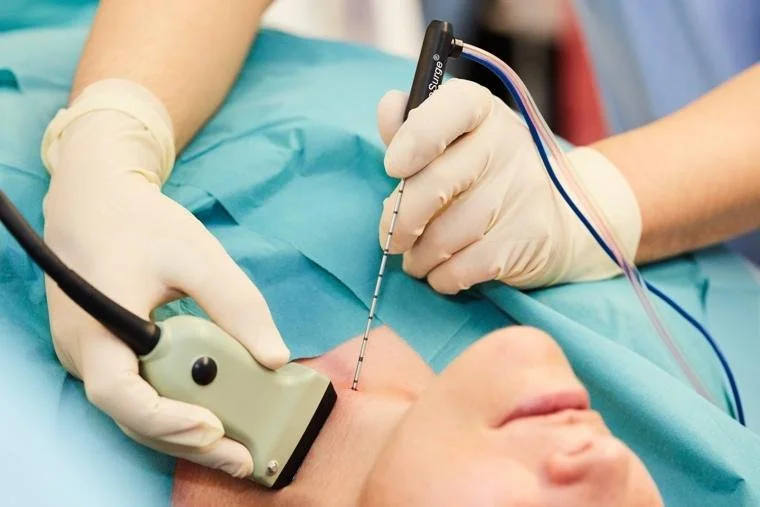
Minimally invasive treatment for thyroid nodules and goitre
Advances in image-guided treatment now allow selected thyroid nodules and enlarged thyroid glands to be treated without conventional surgery.
Dr Bryan Barry provides minimally invasive thyroid treatments including radiofrequency ablation (RFA) and thyroid artery embolisation. These procedures are designed to reduce the size of thyroid nodules or an enlarged thyroid while preserving healthy thyroid tissue where possible.
An alternative to thyroid surgery
Thyroid radiofrequency ablation (RFA) uses a fine needle placed under ultrasound guidance to precisely treat an individual thyroid nodule.
Thyroid artery embolisation is a catheter-based treatment that reduces the blood supply to an enlarged or multinodular thyroid.
Both treatments are performed through very small access points, without a surgical incision in the neck. For appropriately selected patients, they may relieve symptoms, preserve thyroid function and allow a faster return to normal activities.
Frequently Asked Questions
Am I a suitable candidate?
1
The procedure is most suitable for patients with symptomatic, benign thyroid nodules who are looking for an alternative to surgery (thyroidectomy). Suitability is assessed at an initial outpatient consultation, where an interventional radiologist will examine you and review factors such as nodule size and location. Malignant nodules are also feasible but require further investigation and multidisciplinary discussion before proceeding.
Is the procedure performed under general anaesthesia?
2
No, the procedure is typically performed under local anaesthetic with you awake. General anaesthesia is not required. Most patients experience minimal pain and discomfort.
Is the procedure performed as an outpatient?
3
Yes all of our procedures are performed as outpatients. Most patients are discharged the same day after 1–4 hours of observation. Recovery and return-to-work times are generally shorter than with surgery, and scarring at the needle insertion site is minimal. Note someone will need to take you home from the hospital and you will not be able to drive on the same day.
What is the referral process?
4
A referral from your GP, endocrinologist, or surgeon is required to access this service. All treatment decisions are made in collaboration with your referring thyroid specialist. If you have not seen a thyroid specialist , arrangements will be made to organise this. We will then contact you to arrange a consultation based on clinical priority and waiting list availability. If suitable, your procedure will then be booked at the earliest possible date at Liverpool Hospital or Sydney Southwest Hospital.
What is the cost of the procedure?
5
There is no charge for thyroid ablation or thyroid embolisation in Medicare eligible public patients.